Thursday, May 10, 2018

Choosing Character Names

One thing I have been asking myself is how I decided on character names for my story in progress. Do any of you authors out there ever ask yourself such a question?

I still am asking myself why I chose Martin as the protagonist's name, and Rachel for his mother's name. Not to mention Roderick for a classmate and Jana and Janelle for two other classmates (twin sisters).  How do any of those sound to you? Some sites advise against using similar names in the same book, such as this one:


Names That Are Too Similar

If your story has more than just a few key characters, you want to make it very easy for your reader to distinguish between them. That’s why you should avoid using names that sound too similar:
  • Similar beginnings:  Readers might be confused by a “Cathy” and a “Cynthia,” or a “Richard” and a “Roger” in the same story.
  • Similar endings: Avoid giving your characters names that end the same way, like “Madison” and “Jason,”  or worse yet, names that rhyme, like “Shelley” and “Kelly.”
  • Repeated vowel sounds: “Janeen,” “Lee,” and “Edith” all share a long ‘e’ sound. This can be tiring for the ear.
  • Similar length: You’d be confused too if you had to read a book about “Bob,” “Ted,”  and “Joe.” How would you keep them all straight in your mind?
Now, before you go and say you’re writing about a set of twins, just remember: names can have a similar feel without sounding alike. For example, “Matthew” and “Luke,” (both names from the Bible) or “Ava” and “Bette,” (both Hollywood film actresses).
Keep in mind, you want your characters to stand out as individuals, not meld in your readers’ minds.
And from Wikihow:

Even after reading this, I don't intend to change the twins' names. I've known twins to have alliterative names and non-alliterative ones, and even rhyming names. Many boy-and-girl twins I have met do not have alliterative names, and I can only think of one or two such sets of twins that I have met personally.

Also from Wikihow:


I certainly wouldn't name a person in a book Elvis, but might easily use that name for a dog or cat. And I'm not even going to get started on Adolf 🙂

I honestly don't see any reason not use whatever names you want to use. 

How do any of you choose your character names?

Tuesday, May 8, 2018

5 Topics For Your Author Blog

From Writerslife.org:


Finding good topics for your author blog can sometimes be a bit of a struggle. A great blog can be an excellent platform for authors to find new fans and generate interest in their work, but you need to continue to produce fun, engaging, insightful and entertaining posts to encourage readers to keep coming back for more.
You can write about anything you want to in your author blog, but it’s good to remember that people will be interested in finding out more about your characters, your work and you as a writer. If you can create posts that cover these topics your readers will feel as though they know you and your writing better, and that’s what will hopefully motivate them to buy your book!
So what are some great topics to write about? Here are 5 to get you started!
Where you find your inspiration
What inspires an author is fascinating to both fellow writers and non-writers alike. For those who can’t imagine writing a book themselves, it’s so interesting to hear where a person might find the inspiration and motivation to come up with their stories, and for your writing comrades it’s great to get some tips if they are feeling a little creatively uninspired.
How you do your research
A well-researched book is going to be all the better for it! Share with your readers and fellow writers how you begin to research your book. What methods do you use? How do you organise it? If you come across anything particularly interesting, an unusual fact, for example, share this with your readers too!
Character interviews
There is no much you can do with your characters. Why not interview them individually as if they were famous so your readers can get to know them? If they have any unique hobbies, talents or interests, you could write a separate blog on this topic, for example, ‘how to bake the perfect pie by [insert character name here]'. Also if your characters face particular struggles, you can share how they overcome them in separate posts.
Create polls
Polls and votes are a great way to get your readers interacting with your work. Get them to vote on anything, character names, the outcome of a particular storyline, your new book cover and so on. This is not only brilliant free market research for you, but will get readers talking and thinking about your book which will make them more invested.
Your writing ritual
Many writers have various routines and rituals that they like to undertake when starting the writing process. Do you have any weird and wonderful habits that you can turn into an entertaining blog post to share with your readers? Talk about your writing process, what you need to get started, and your writing space so they have a little insight into how and where the magic happens!
These five topics work for any author blog, so if you are stuck for ideas why not create these posts and hopefully they’ll inspire you to write even more.

I didn't originally set out to do an author's blog, or even a writer's blog, just  a blog where I could write about anything I want. And I have found it easier to have all posts on one blog, rather than trying to start another one or two blogs. But as those who have views my blog recently can see, I have had a great deal of posts about what I am writing. One can see in recent posts how I chose to write something set in the 1980s and how I have included pre-tech items such as using an encyclopedia. I think others should learn what life was like before the Internet and cell phones. 
Have any of you who have written stories tried interviewing your characters? I haven't, but since I was doing a memoir, it seems weird to even try. It's about me, after all, and I know about me already.🙂 But as far as the protagonist in my diary novel goes, I've stated how he is riddled with anxiety over having to get braces. He readily gives up chewing gum and eating candy, pretzels and popcorn in preparation. I don't agree with my mom's friend's statement that he is "extremely cynical"; rather, he's just displaying teen angst. References are made to A Wrinkle in Time and Lord of the Rings (a cat called Frodo). That might tell readers something about him. 🙂 "Just be glad you're a cat and not a nerd like me," he tells the cat, referencing Meg in Wrinkle saying, "Just be glad you're a kitten and not a monster like me" to her kitten.

Maybe now I should ask what others think of my character names? Or the storyline?
I have been trying to write about my work-in-progress, making sure not to spoil the end, though I have not come there yet. But I now think I know what will happen.

Sunday, May 6, 2018

The Importance of the Point of View

From Writerslife.org:


One of the most critical decisions any writer has to make is whose point of view they are going to tell their story from. The whole relationship between the writer and their story is set when they make this decision.
The viewpoint from which a writer tells a story determines its whole outlook, and each perspective comes with its own devices that can give writers great freedom, but also limit them too.
So how does one decide which point of view to use? Let's take a look at some of the different types.
First person singular. The first person singular point of view gives writers an opportunity to make the story genuinely personal.
The readers will follow the story through a single characters eyes; this can make them feel very bonded to that character and allows the scope to play with the intimacy between reader and character as well as create a sense of immediacy which can help to keep the story moving along.
However, this viewpoint means that only one side of the story is told. The narrator's knowledge of events and the way they see the world is the only opportunity for readers to get what is going on. If the novel has a large cast of other interesting characters, it may be challenging to get readers to have the same connection or identify with them.
Third person limited
Third-person limited tells the story from only one person’s perspective but as if the reader was following them around and observing.
This point of view allows readers to gain a slightly broader perspective while still being permitted to understand the characters innermost thoughts and feelings without being bound to their particular opinions.
This perspective allows the writer to prove the protagonist wrong or reveal biases that the character does not even know that they have. The writer maintains control and authority while still being able to tell the story of one particular individual that the readers follow throughout.
Third person omniscient
Using this viewpoint means that many different characters perspectives are explored. This allows the reader to see many different sides of the story, and to get to know a whole cast of characters on a more intimate level.
However, employing this perspective can mean that the reader has to work harder to make sure they know whose viewpoint they see things from, and if there are too many characters and perspective switches too regularly, it is possible they could become confused, frustrated and unable to follow the story any longer.
Of course, writers are perfectly entitled to choose whichever perspective they wish, and may even want to mix in two or three different views in their story (though be warned this could confuse your reader if not done well). Whatever you chose, it is worth giving some time and consideration to point of view, and experimenting with it to find the best way to tell your story just as it should be told.

It should be obvious that a memoir would be written in the first-person, since the author is narrating something about his or her life. And epistolary novels are generally in the first-person, since they are written in the form of a diary, blog, letter, email, etc. I knew that when attempting these two formats that first-person was going to be how to write it.However, in the past, when I attempted to write stories, I nearly always chose the third-person, since I was attempting fiction. It seemed to me then like the first-person should only be used for autobiography, even though I had seen fiction books written in the first-person. One trouble I had at first when trying to written the first-person was how not to repeat the pronoun "I." In third-person narration, it's  easy to vary noun and pronoun usage without repeating "he," "she," "it," or "they"  or the name(s) of the character(s). But now that I have been writing in first-person, I have found it easier to do so.

One thing I immediately look for when reading first-person-narrated books is how and when the name of the protagonist is revealed, either in the narration by the protagonist himself, or or in dialog spoken by another person. Here was how I introduced the name of the protagonist in my diary novel:

I hate the fact that she [his mother] chose to use her maiden name Martin as my first name. She no doubt would have done the same thing if her last name had been Thomas or Douglas.  Or God help me—Gordon. Oh, why couldn’t her name have been Cooper or Tyler? Jordan even.  Any one of those would have sounded much cooler.  I bet she’s glad she wasn’t named Smith or Jones—would she have named me either of those? My middle Charles came from my late father Charlie. I hate my last name because of the girl named Blair on the TV show Facts of Life  and because of the actress Linda Blair from the movie The Exorcist.

Those who have written fiction in first-person, how do you introduce the name of your protagonist to the reader?

And who here has ever attempted the second-person narration? That one seems harder to do. Just as I originally had trouble not repeating the pronoun "I" when attempting to write in the first person, I likely would have had the same trouble not repeating "you." And it seems that second-person is mostly best for interactive books such as the Choose Your Own Adventure series. Neil Patrick Harris parodied the format of the CYOA books for his memoir, Choose Your Own Autobiography. I now feel like reading Bright Lights, Big City, to read something other than an interactive book. Goodreads has a list of popular second-person books, most of which I have never heard of. 

What is your preferred post-of-view for fiction? I'm now seeing the first-person used in many fantasy and dystopia novels, such as The Hunger Games and Twilight book series. If I choose to ever attempt a book in these genres, I will have to decide hard on what point of view to choose.

Friday, May 4, 2018

Chapter Break Bingo – May 2018

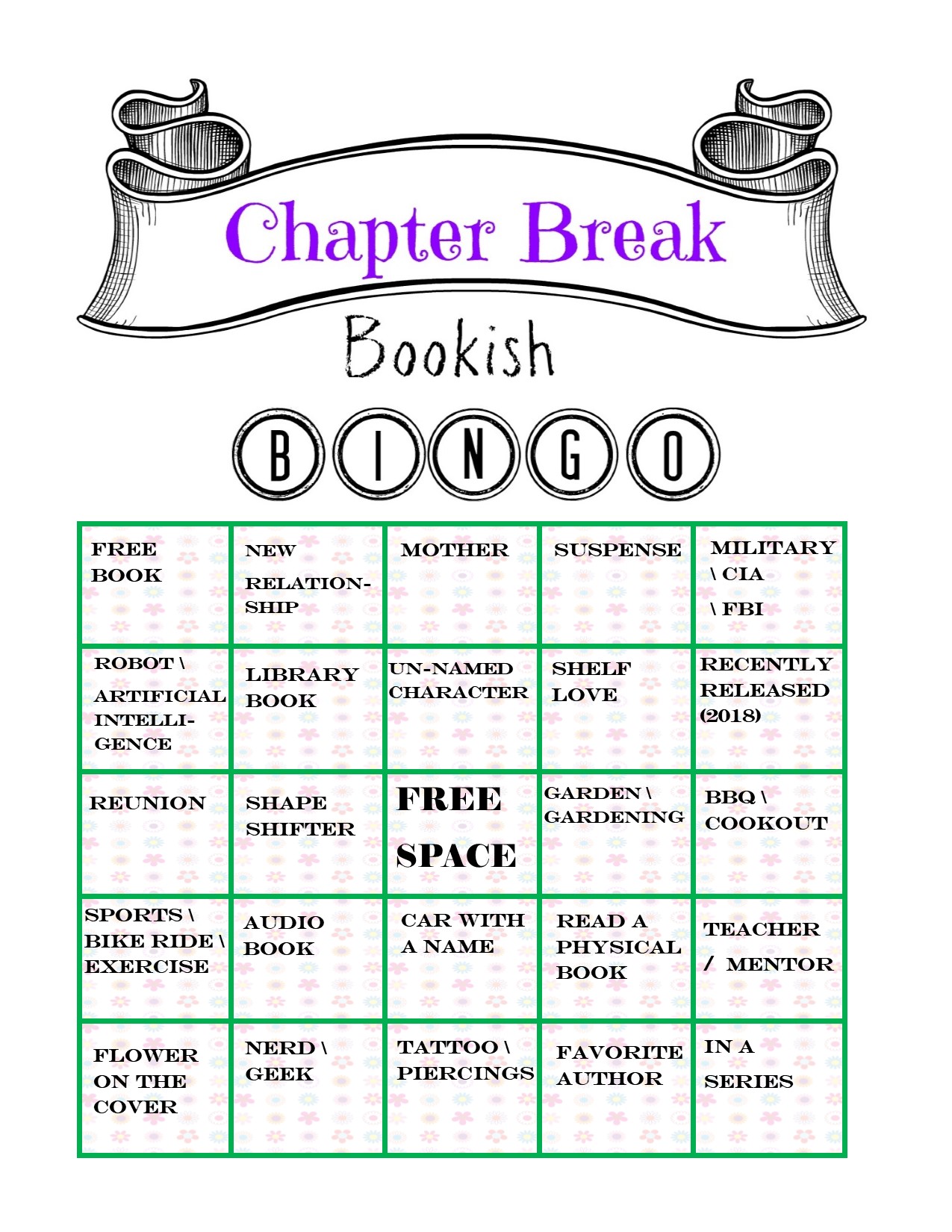
Here is the new card for May. Some categories this month are a little out of my comfort zone, but that makes it fun:)

Click on the card to download (or right click here and save-as).
Mark up the card however you wish to claim the squares.

Here’s a recap for clarity (with specific dates for example):
May 4 – new bingo card available
June 3 – Julie and I will post our May completed bingo cards. You can link up your bingo cards in this post
June 4 – new bingo card available
July 2 – Julie and I will post our June completed bingo cards. You can link up your bingo cards in this post. We will also be posting the May winner of the most squares in this post.
And so on and so forth.

 Here is what I am reading:
  1. Lily's Crossing--Patricia Reilly Giff (3 squares): Library Book, New Relationship, Physical Book
  2. The Gathering of Zion--Wallace Stegner (1 square): Favorite Author
  3. Always and Forever, Lara Jean--Jenny Han (1 square): In a Series
  4. The Pearl--Angela Hunt (3 squares): Free Book, Mother, Flowers on Cover
  5. The Outsider--Nathaniel Lachenmeyer (1 square): Free Space
  6. Spare Parts--Joshua Davis (8 squares): Robot/Artificial Intelligence, Shelf Love, Military/CIA/FBI, Suspense, Nerd/Geek, Teacher/Mentor, Bike Ride, Unnamed Character
  7. Last Light Over Carolina--Mary Alice Monroe (2 squares): Audiobook, Cookout
  8. America is Not the Heart--Elaine Castillo (1 square): Recently Released
  9. Three Wishes--Lianne Moriarty  (1 square): Garden
  10. Tan Lines--Katherine Applegate (1 square): Reunion
  11. Nightshade--Andrea Cremer (2 squares): Shape Shifter, Tattoo/Piercings
24 Squares completed on May 28.

Thursday, May 3, 2018

How to Stay on Track During the Warmer Months

From Writerslife.org:


With the weather getting warmer and warmer, it can be easy to get off track as your focus tends to be geared towards getting outside. While it can be difficult to focus, it need not continue that way. It’s possible to be focused on your work and also enjoy the sunshine. 
Instead of planning activities outdoors during working hours why don’t you work outside! This will allow you to enjoy the sun while also allowing you to get your work done.
Try getting up earlier in the day. When you get up earlier in the day, you can end your day earlier as well. Instead of working the typical 9 to 5, work 8 to 4 or even 7 to 3, do what you feel comfortable with. With spending time outside you don’t want to waste working hours where you could be productive. The goal is to be productive while also enjoying the warmer weather. 
Set goals for yourself each day. Set 5 to 10 big goals for yourself during the week. When you accomplish these goals, you get the rest of the week off! If you set a goal to write 10,000 words for your book and you get it done by Thursday morning, then you can stop working again until Monday! You don’t want to deprive yourself of the summer sun.
The last step towards staying on track during the warmer months is to plan activities for yourself each weekend. It’s easy to want to stop working and go outside, yet this isn’t possible if you want to be productive. Plan outdoor activities for yourself each weekend. These are activities that will allow you to push yourself through the week and allow you to take the weekend in stride! 
No one said it would be easy getting work done during the summer months, but it’s entirely possible if you follow the steps addressed above!

Yes, it's getting close to that time of the year. Right now the weather in my neck of the woods is not quite cold yet not quite warm, though temperatures in the 70s and above are expected in the next few days. I can get easily tired no matter what the weather, but am dreading to see just how tired when the summer heat hits. Along with fatigue coming from the hot weather, I also have trouble sleeping during the hot weather and will often wake up tired. 

Yes, I agree that hot weather can make it hard to concentrate, not just on writing, but just about everything. It's often to hot for me to want to just go outside or even to the store or somewhere. 

And I now wonder what I will be working on this summer. I'll either be getting back to the memoir or continuing the diary novel or possibly starting something new, maybe the sequel I seem to be envisioning to the diary. All this is still to come. 

Wednesday, May 2, 2018

Words for Wednesday

The prompts this month are Elephant's Child's blog, but are provided by Margaret Adamson, and her friend Sue Fulton.  They also include photographs taken by Margaret's friend Bill Dodds.


This week's prompts are:

  1. baptism
  2. dregs
  3. pinafore
  4. exploring
  5. sugar
  6. bee hive 

And/or

  1. heart
  2. meddling
  3. primary
  4. contrary
  5. mug
  6. kitchen

In his kitchen, Wallace Brenner had many reminders and dregs of the woman he once loved and lost when an exploring incident took her life. There was a flowered mug decorated with hearts and a pink sugar container. On the wall hung her lacy pinafore that she loved wearing in the kitchen. In the kitchen drawer was record of baptism. 

Since then Wallace never went exploring himself, having once nearly come in contact with a bee hive. He rarely even left his house anymore, preferring to avoid most of society, and choosing to live as a recluse, with his kind, albeit somewhat meddling doorman as his primary aide and confidant.

"It's just how I choose to be now," Wallace said. He was a writer and found this living style suited to his work. The doorman was the one helped him get his work submitted with the hope on one day getting published. 

"I do not feel lonely anymore, even though I lost someone I once loved but contrary to what you may think that  I feel, I do not hate others," he wrote at the beginning of a story he was beginning to attempt. "People come and go, but in the end, you are the most important person to you. I love who I am and I don't need others, only myself." He also noted that writers have tended to be recluses and that that life was best for him.

He began to see the pinafore as a metaphor for something, and was hoping to use it in his story somehow.

Tuesday, May 1, 2018

Mental Health Month

It is already the first day of May, and the start of Mental Health Month.


I have been aware of Mental Health Month since I began services. Our center will be having booths this month at the town's annual Farmers Market (it starts tomorrow and runs through September). 

I now want to find some books to read for this month on the topic. I may just re-read Prozac Nation, or dive into Darkness Visible, William Styron's mental-illness memoir.  Strangely, only one of my reading challenges with monthly themes has mental illness as the theme for May. This one chose Mental Illness as the theme for August. But I think it's good to be aware all year long, especially when you are going through mental issues yourself. I've been brave enough to write about it in a book.  I was angry when the Mental Illness reading challenge I had been participating in for the last two or three years was deleted. Perhaps I can start a new one for 2019. Something to think about.


Also, many people I have encountered still aren't aware of Dysthymia, or Persistent  Depressive Disorder.  It seems I have not yet encountered others with this same diagnosis. Bipolar Disorder and  Schizophrenia seem to be more common among the others I have met at the mental health center I attend at work at. Before I learned my diagnosis, I was suspicious, from what I'd known about Bipolar Disorder, that I might have that one, or possibly its milder variant known as Cyclothymia, another condition no one I have encountered seems to have. 


Here are some facts about Dysthymia (from epainassist.com):

  • Dysthymic Disorder is a medical condition affecting the mood of a person where the person may be normal one day and may feel extremely low in mood the next.
  • It is a form of mild depression which stays for a prolonged period of time.
  • The symptoms of Dysthymic Disorder are less severe than the symptoms of a major Depressive Disorder.
  • Dysthymic Disorder usually begins in the teenage years and can last for a prolonged period of time going on for at times even decades.
  • Dysthymic Disorder is more seen in women than in men
  • Dysthymic Disorder was also in the past known by the name of depressive neurosis, neurotic depression, and depressive personality disorder.

I can honestly say I have felt more than one of those things. One thing I said at the beginning of my memoir was:

It took me a long time to realize that I was depressed--not just “down in the dumps on any given day,” but in need of an antidepressant. ...
Definitely a prolonged period of time for me.

I'm glad to have the support of the mental health center and to be one to help end the stigma toward mental  health issues.